


Secure & Sovereign Digital Health Architecture for Military Healthcare
Origin language: English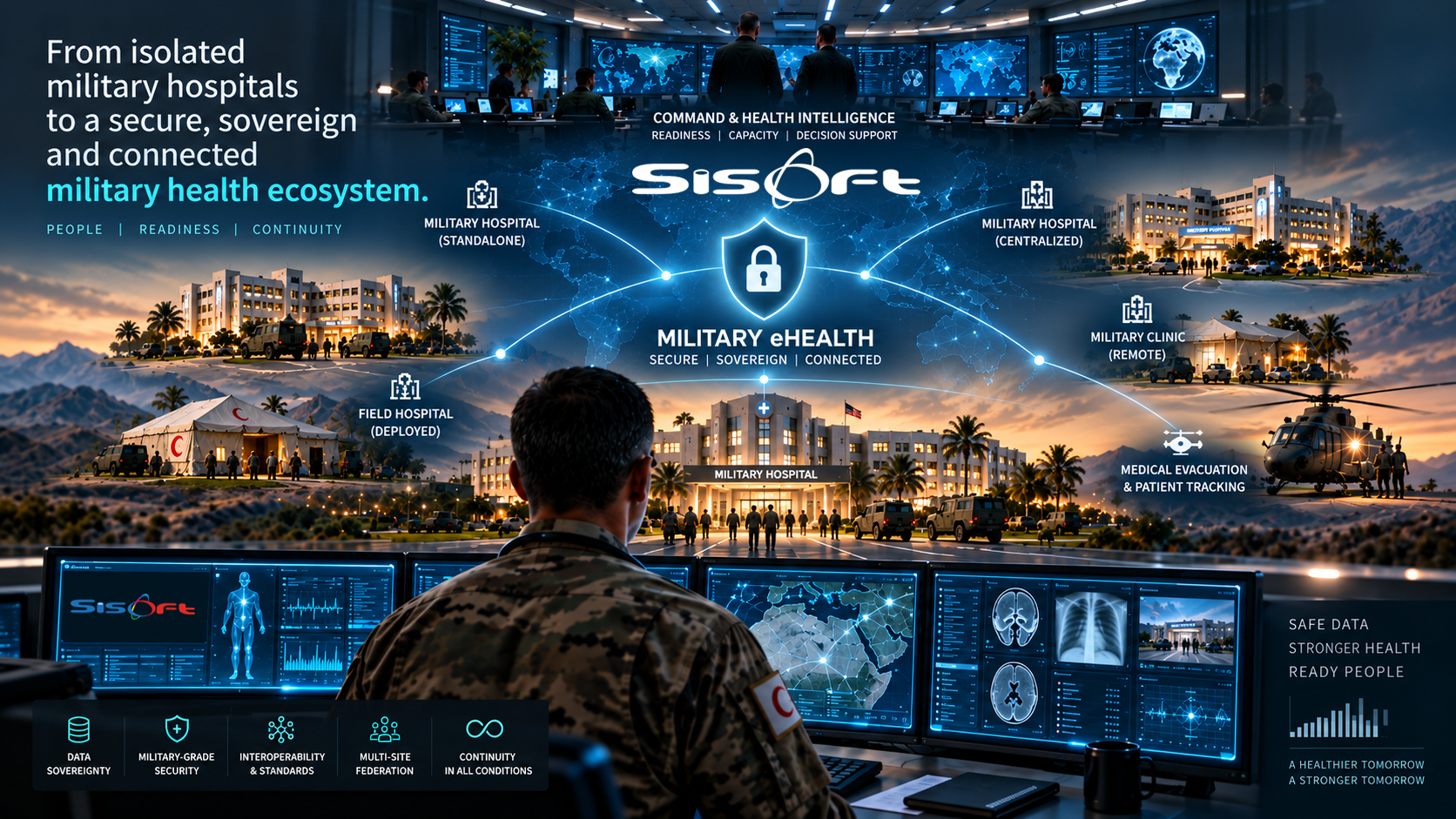
Project Description
Military healthcare requires far more than conventional hospital software. It requires a secure, sovereign, resilient and interoperable digital health architecture capable of supporting healthcare delivery across highly controlled, mission-critical and potentially disconnected environments.
The Secure & Sovereign Digital Health Architecture for Military Healthcare was designed to address this challenge. It provides a comprehensive digital health framework for military hospitals, clinics, specialized medical facilities and other authorized healthcare environments while preserving the security, autonomy and sovereignty required by defense organizations.
The architecture supports centralized, standalone and federated deployment models. Multiple military hospitals may operate on a common centralized infrastructure, while other facilities may remain completely independent with their own local systems and databases. These standalone facilities can be securely connected through a Military eHealth ecosystem, allowing specifically authorized clinical and operational information to be exchanged without requiring every institution to use the same hospital information system.
This federated approach is particularly important in military healthcare. Information does not have to be universally centralized to become clinically useful. Each organization can retain control of its own systems and data while defined information is made available to authorized healthcare professionals and institutions according to security policies, operational requirements and access privileges.
Security, Sovereignty and Resilience
Security is embedded in the architecture rather than added as a separate layer after implementation. The platform can operate within air-gapped, restricted-network and on-premise environments, supporting organizations where healthcare information must remain within nationally or institutionally controlled infrastructure.
The architecture incorporates role- and mission-based authorization, controlled information visibility, comprehensive auditability, data sovereignty and secure information exchange. Different users, facilities and organizational levels can therefore access only the information appropriate to their responsibilities and authorization.
Operational resilience is equally important. Military healthcare cannot depend entirely on permanent external connectivity. Hospitals and healthcare facilities must be capable of maintaining local operations when networks are restricted, unavailable or deliberately isolated, while supporting controlled information exchange whenever permitted by the security architecture.
An Integrated Military Healthcare Ecosystem
The project extends beyond the traditional HIS. Clinical, diagnostic, administrative and operational capabilities can be integrated within a common digital health ecosystem, including HIS, LIS, RIS/PACS, ICU, Emergency, Operating Room and Anesthesia, Pharmacy, Blood Bank, ERP, EDMS and other specialized healthcare systems.
This enables information generated throughout the patient journey to support continuity of care while also providing authorized management levels with the information required for healthcare planning, resource management and operational decision-making.
The architecture can also accommodate different healthcare environments—from major military hospitals and specialized facilities to geographically separated healthcare units—creating the foundation for a broader Military eHealth infrastructure.
Proven in a Real Military Healthcare Environment
A major strength of the project is that its architecture is based not only on conceptual design but also on real-world military healthcare implementation experience.
During implementation in a military healthcare environment, more than 2,000 adaptations were carried out. These adaptations addressed several fundamentally different requirements: national and regulatory requirements, clinical and hospital-specific workflows, operational requirements, and—importantly—a substantial range of military security and information-governance requirements.
This experience demonstrated that military healthcare localization goes far beyond translating interfaces or modifying clinical forms. A military digital health platform must be capable of adapting its security model, authorization structures, workflows, information visibility, interoperability mechanisms and operational architecture to the specific requirements of the organization and country in which it operates.
For security reasons, sensitive implementation details are not publicly disclosed; however, this extensive field experience has become an important foundation of the architecture.
From Isolated Systems to a Connected Military Health Ecosystem
The ultimate objective is not simply to digitize individual military hospitals. It is to enable healthcare organizations to evolve from isolated systems toward a secure, sovereign and connected military health ecosystem.
Centralized facilities can operate together. Standalone hospitals can preserve their autonomy. Authorized information can move securely through Military eHealth services. Healthcare professionals can access the information required for continuity of care, while military and healthcare authorities maintain control over where data resides, how it is exchanged and who is permitted to access it.
The result is an architecture designed to support continuity of care, operational readiness, interoperability, resilience and informed decision-making without compromising security or national data sovereignty.
From isolated military hospitals to a secure, sovereign and connected military health ecosystem.
Military healthcare environments present challenges that go far beyond conventional hospital digitalization. One of the most significant was migrating historical clinical and administrative data from legacy systems while preserving data integrity, patient identity, clinical continuity and compatibility with the new architecture.
Integration with external systems and services was another major challenge. Laboratory and imaging devices, national and institutional services, identity systems and other third-party platforms often use different technologies, standards and data structures. In high-security environments, each integration also requires careful consideration of what information may enter or leave the protected network.
Security requirements fundamentally changed the implementation and support model. Some environments operate within air-gapped or highly restricted networks with no direct Internet connectivity and no conventional remote access for technical teams. Consequently, installation, configuration, troubleshooting, updates and maintenance procedures that would normally be performed remotely had to be redesigned for controlled on-site or securely governed operations.
The system also needed to remain functional during offline, disconnected or restricted-connectivity conditions, ensuring that critical healthcare services were not dependent on continuous external connectivity.
A further challenge was adapting a comprehensive digital health platform to country-specific legislation, military security policies, organizational hierarchies and highly specialized clinical workflows. In one major military implementation alone, more than 2,000 regulatory, clinical, operational and security-specific adaptations were required.
Multilingual operation, localization of extensive clinical content, interoperability across heterogeneous systems, strict authorization structures, comprehensive auditability and protection of data sovereignty added further complexity.
These challenges demonstrated a central lesson of the project: military healthcare digitalization cannot simply replicate a conventional hospital implementation. Security, sovereignty, resilience, interoperability and operational continuity must be designed into the architecture from the beginning.
A fundamental lesson from military healthcare implementations is that security, sovereignty and operational continuity must be architectural principles from the beginning, not additional features introduced after deployment. Security policies, data classification, network restrictions, authorization hierarchies and information-sharing rules should therefore be defined together with military, healthcare and technical stakeholders during the earliest analysis phase.
Local autonomy should be preserved wherever operational or security requirements demand it. Military hospitals should be able to operate independently, including in air-gapped, offline or restricted-network environments. At the same time, a federated Military eHealth architecture can enable authorized information exchange between standalone facilities without requiring every hospital to use the same system or centralize all data.
A comprehensive pre-implementation assessment of existing infrastructure, legacy systems, historical data and third-party integrations is essential. Data migration should be treated as a clinical continuity process rather than simply a technical transfer, with patient identity, data integrity and historical accessibility carefully validated.
Interoperability should be based on internationally recognized standards such as HL7, FHIR, DICOM and established clinical coding systems, while allowing controlled adaptation to national regulations and military-specific requirements. Interfaces with external systems should follow clearly defined security boundaries and data-exchange policies.
Another critical success factor is deep localization through continuous stakeholder involvement. Military healthcare cannot be effectively implemented through generic configuration alone. Clinical teams, hospital management, IT specialists and authorized security stakeholders should participate throughout analysis, adaptation, testing and acceptance. Our experience, including more than 2,000 adaptations in a major military healthcare implementation, demonstrated the importance of combining regulatory, clinical, operational and security-specific localization.
Where remote access is prohibited, on-site expertise, controlled update procedures, comprehensive audit mechanisms, documentation, knowledge transfer and local technical capacity become essential for sustainable operations.
Finally, scalability should not mean forcing every facility into one architecture. A sustainable military digital health strategy should support centralized, standalone and federated models simultaneously, enabling new hospitals and healthcare units to join the ecosystem according to their security classification, infrastructure and operational requirements.
The key principle is simple: standardize what must be shared, localize what must remain specific, connect what is authorized, and protect what must remain sovereign.
Standardize what must be shared, localize what must remain specific, connect what is authorized, and protect what must remain sovereign.

