


Breaking the Language Barrier in Digital Health: Multilingual and Clinical Localization
Origin language: English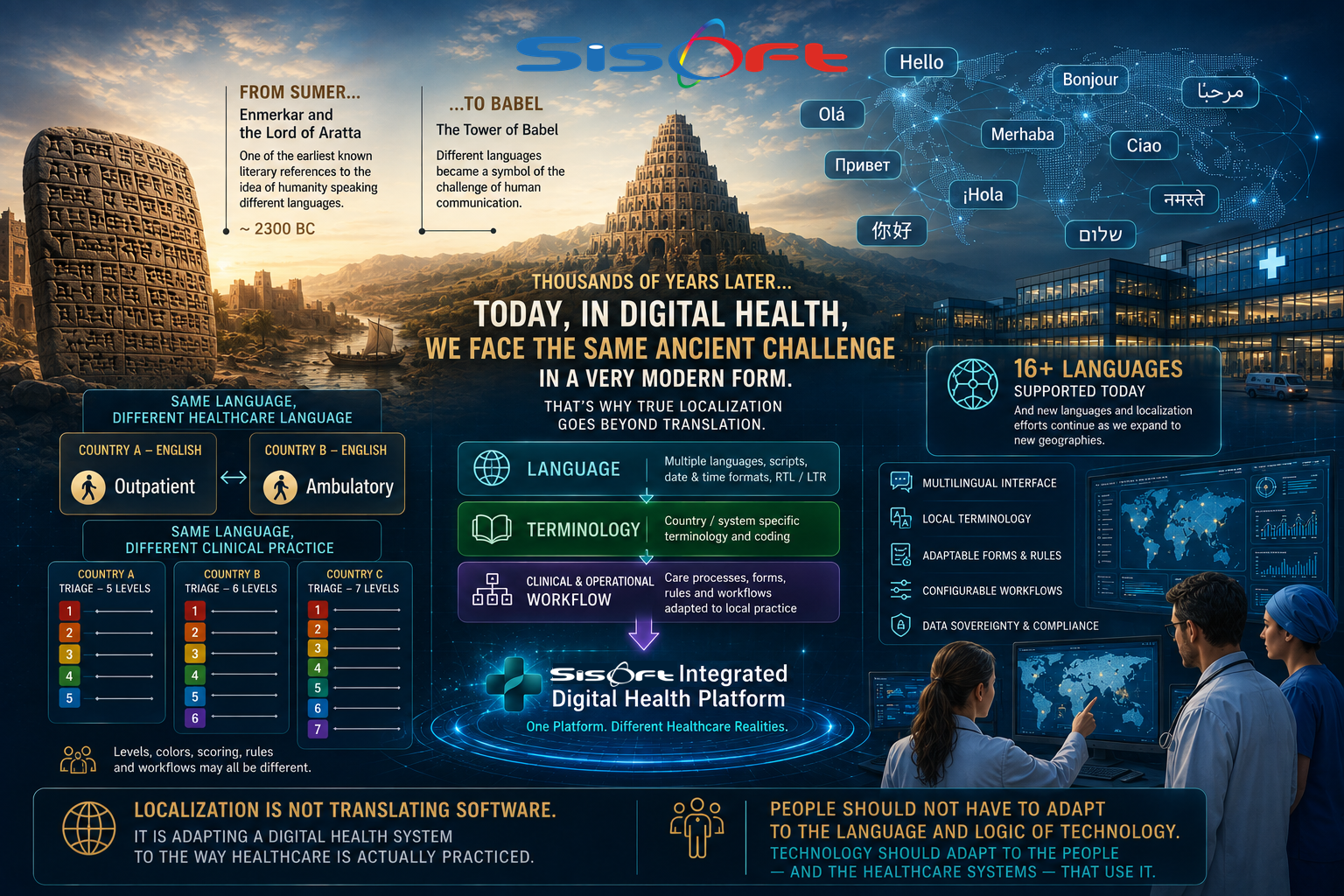
Sisoft’s Multilingual and Clinical Localization Framework enables digital health systems to adapt not only to different languages, but also to country-specific healthcare terminology, clinical practices, regulatory environments, and operational workflows.
The Sisoft Integrated Digital Health Platform currently supports 16+ languages, with additional languages and localization capabilities continuously being developed.
The framework goes far beyond screen translation. Even countries using the same language may use different healthcare terminology and clinical models. Terms such as Outpatient and Ambulatory may vary by country, while triage systems may use 5, 6, or 7 levels with different classifications, colors, clinical rules, and workflows.
Drawing on nearly 40 years of health IT experience and implementations across multiple countries, Sisoft enables language, terminology, clinical processes, patient-facing services, and operational workflows to be localized within a single integrated architecture.
This approach benefits both healthcare professionals and patients. Healthcare professionals can work within terminology and workflows appropriate to their local healthcare environment, while patients can access digital health services, including patient-facing applications and portals, in languages and formats appropriate to them.
Our principle is simple: healthcare professionals and patients should not have to adapt to the language and logic of the software; the software should adapt to them.
By 2027, the project aims to further expand beyond 16 languages and strengthen country-specific terminology, clinical and operational localization capabilities, contributing to the elimination of language and localization barriers in digital healthcare worldwide.
One of the main challenges has been adapting the platform to different healthcare environments while maintaining a consistent core architecture. Localization goes far beyond direct language translation, as medical terminology, workflows, forms, clinical practices, reporting requirements and even commonly used healthcare terms may differ significantly between countries.
Each country also has its own digital health ecosystem and local integration requirements. For example, implementations may require integration with national or regional health platforms such as e-Nabız in Türkiye and NABIDH in Dubai, as well as country-specific payment and insurance ecosystems such as MoMoPay in Rwanda and QLM in Qatar. Similar requirements may involve national identity systems, laboratories, imaging systems, medical devices, e-prescription services and regulatory reporting platforms. These integrations must often be adapted independently while preserving the integrity of the core platform.
Infrastructure conditions can also vary considerably between countries and healthcare facilities. Internet connectivity, network architecture, hardware availability, cybersecurity requirements and local technical capacity may influence implementation and require different deployment approaches.
Process-related challenges include resistance to change, transitioning from paper-based or fragmented systems to integrated digital workflows, staff training and ensuring sustained adoption by clinical and administrative users. Successful digital transformation therefore depends not only on software, but also on organizational readiness, governance and active participation of healthcare professionals.
Regulatory requirements may also evolve during implementation, particularly in areas such as data protection, interoperability, national health reporting and procurement rules. International implementations therefore require continuous localization, close cooperation with local teams and authorities, and the flexibility to adapt to country-specific requirements without disrupting existing healthcare services.
Key best practices identified during the project include maintaining a strong common core platform while allowing controlled localization for each country, healthcare organization and regulatory environment. This approach improves scalability, reduces duplication and makes future deployments faster and more sustainable.
Early involvement of key stakeholders is critical. Hospital management, clinicians, nurses, administrative teams, IT departments, ministries, regulators and local partners should be involved from the analysis and design stages. Their participation helps ensure that workflows reflect real operational needs and significantly improves user adoption.
Localization should be treated as a clinical and operational process rather than only a translation activity. Medical terminology, forms, workflows, reporting structures and integrations should be validated together with local healthcare professionals and technical teams.
Another important best practice is to integrate with existing national and local digital ecosystems instead of creating isolated systems. Examples include national health platforms, insurance systems, payment infrastructures, identity services, laboratory and imaging systems, and regional health information exchanges. Designing integrations through standardized and reusable interfaces supports long-term interoperability and reduces the cost of future expansion.
A phased implementation approach, supported by continuous training, close on-site or remote support and regular feedback from users, also improves adoption. Digital transformation is more sustainable when healthcare professionals understand not only how to use the system, but also how new digital workflows improve clinical and operational processes.
From a technical perspective, modular architecture, interoperability standards, strong security controls, centralized data management and multilingual capabilities are important for scalability. The same core platform should be capable of supporting different infrastructure models, including cloud and on-premise deployments, as well as highly restricted or fully offline environments. This is particularly important for military hospitals and other high-security healthcare facilities, where systems may be required to operate within closed, air-gapped networks without external internet connectivity, while still providing full clinical, administrative and operational functionality.
From a policy and sustainability perspective, clear national standards, interoperability requirements and digital health governance significantly facilitate implementation. Alignment between government policies, healthcare institutions and technology providers reduces fragmentation and enables successful solutions to be expanded across hospitals, regions and countries.
Overall, the project demonstrates that scalable digital health transformation requires a combination of standardized technology, strong local adaptation, stakeholder ownership, continuous capacity building and long-term cooperation between healthcare institutions, public authorities and technology providers.

