


Integrated Digital Health Platform for Tertiary Care – King Faisal Hospital Rwanda
Origin language: English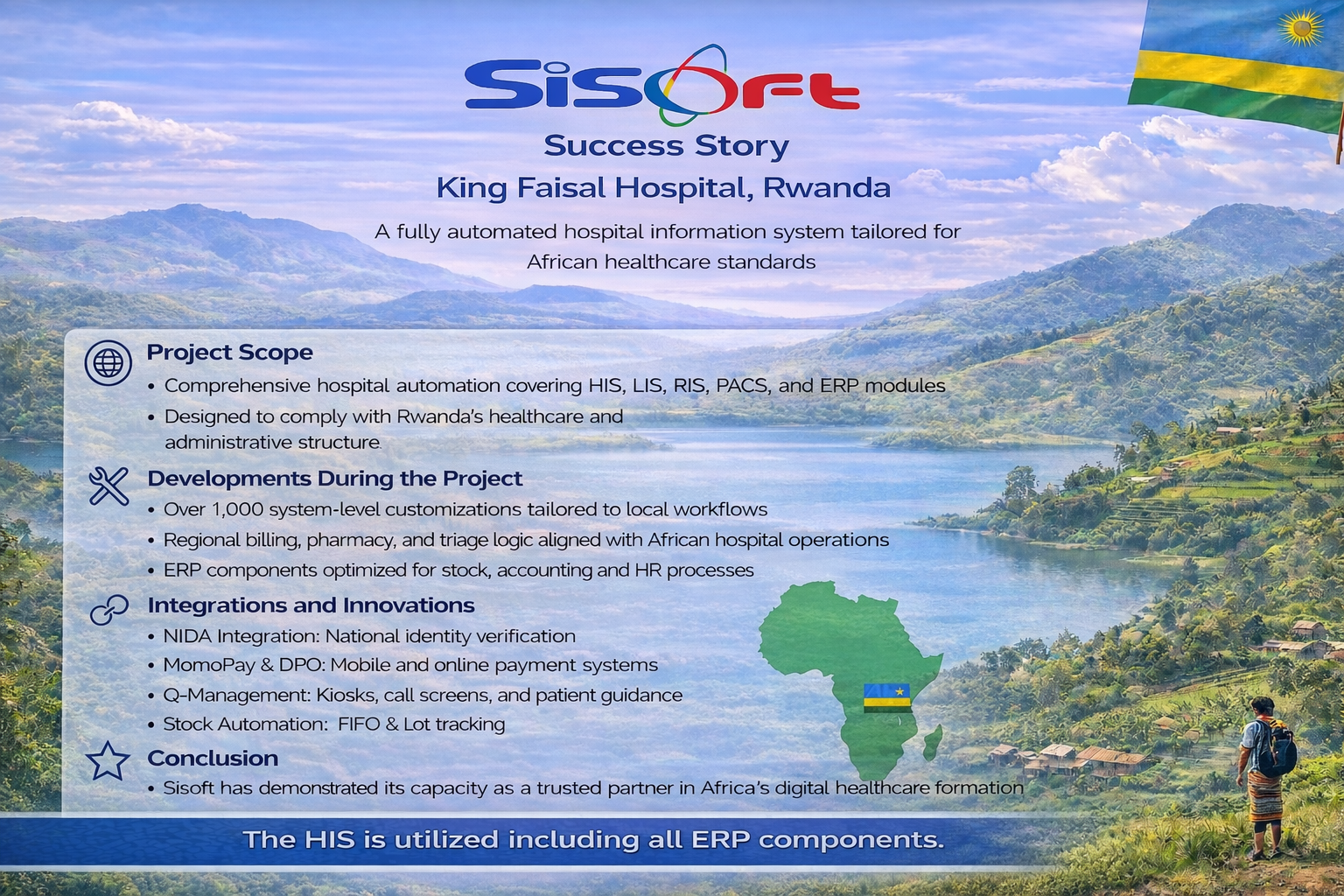
The project implements an integrated digital health platform at King Faisal Hospital in Rwanda, centralizing clinical and administrative workflows across hospital departments. The platform supports secure electronic medical records used by more than 1,100 healthcare professionals and improves care coordination, patient safety, and operational efficiency through structured digital clinical processes. It also integrates with Rwanda’s national digital infrastructure for identity verification and mobile payment services, while enabling data-driven hospital management through standardized documentation, reporting, and analytics.
The implementation of a comprehensive digital health platform in a large tertiary hospital environment required addressing several organizational, operational, and technical challenges.
One of the main challenges was workflow adaptation and change management. The hospital previously operated with established operational practices that required careful alignment with the digital system. For example, in the pharmaceutical and medical inventory management processes, the hospital used batch number–based stock tracking instead of the traditional FIFO approach, which required additional system configuration and customization to ensure accurate traceability and compliance with internal procedures.
Another important challenge was the implementation of a complex patient flow management system, including self-service kiosks and a queue management (ticketing) infrastructure. The system needed to coordinate multiple service points, registration workflows, and real-time patient routing, which required careful integration with the hospital information system to ensure efficient patient movement and reduced waiting times.
In addition, the integration of mobile payment infrastructure (MoMoPay) introduced another layer of complexity. Mobile payment platforms required secure financial transaction handling, integration with billing modules, and alignment with local digital payment ecosystems, which involved additional technical coordination and validation.
Finally, ensuring system interoperability, data security, and uninterrupted clinical operations during the transition phase required phased deployment, continuous user training, and close collaboration with hospital staff to ensure a smooth transition from previous operational practices to a fully integrated digital health environment.
Several lessons and best practices emerged during the implementation of the digital health platform.
First, strong engagement of hospital leadership and clinical stakeholders proved critical for successful adoption. Early involvement of physicians, nurses, administrative staff, and IT teams helped align the digital system with real clinical workflows and reduced resistance to change.
Second, implementing the platform using a modular and phased deployment approach significantly improved operational stability. Gradually activating modules such as patient registration, clinical documentation, pharmacy management, billing, and queue management systems allowed hospital teams to adapt progressively while maintaining uninterrupted clinical services.
Another important recommendation is to ensure flexibility in system design to accommodate local operational practices. For example, inventory management processes and payment infrastructures may vary across institutions and countries. Systems should therefore support configurable workflows, including different stock tracking methods and integration with local digital payment platforms.
In addition, interoperability and standards-based architecture should be prioritized to ensure long-term scalability and integration with national digital health systems, laboratories, medical devices, and external health platforms.
Finally, continuous training and capacity building for hospital staff is essential to ensure sustainability. Digital health platforms should be accompanied by ongoing technical support, user training, and governance mechanisms that allow institutions to continuously optimize their digital workflows as healthcare needs evolve.
Overall, the experience demonstrates that large-scale digital health platforms can successfully transform hospital operations when technology, clinical workflows, governance structures, and capacity building evolve together within a coordinated digital health ecosystem.

