


Central Clinic Azerbaijan – Multi-Hospital Integrated Digital Health Platform
Origin language: English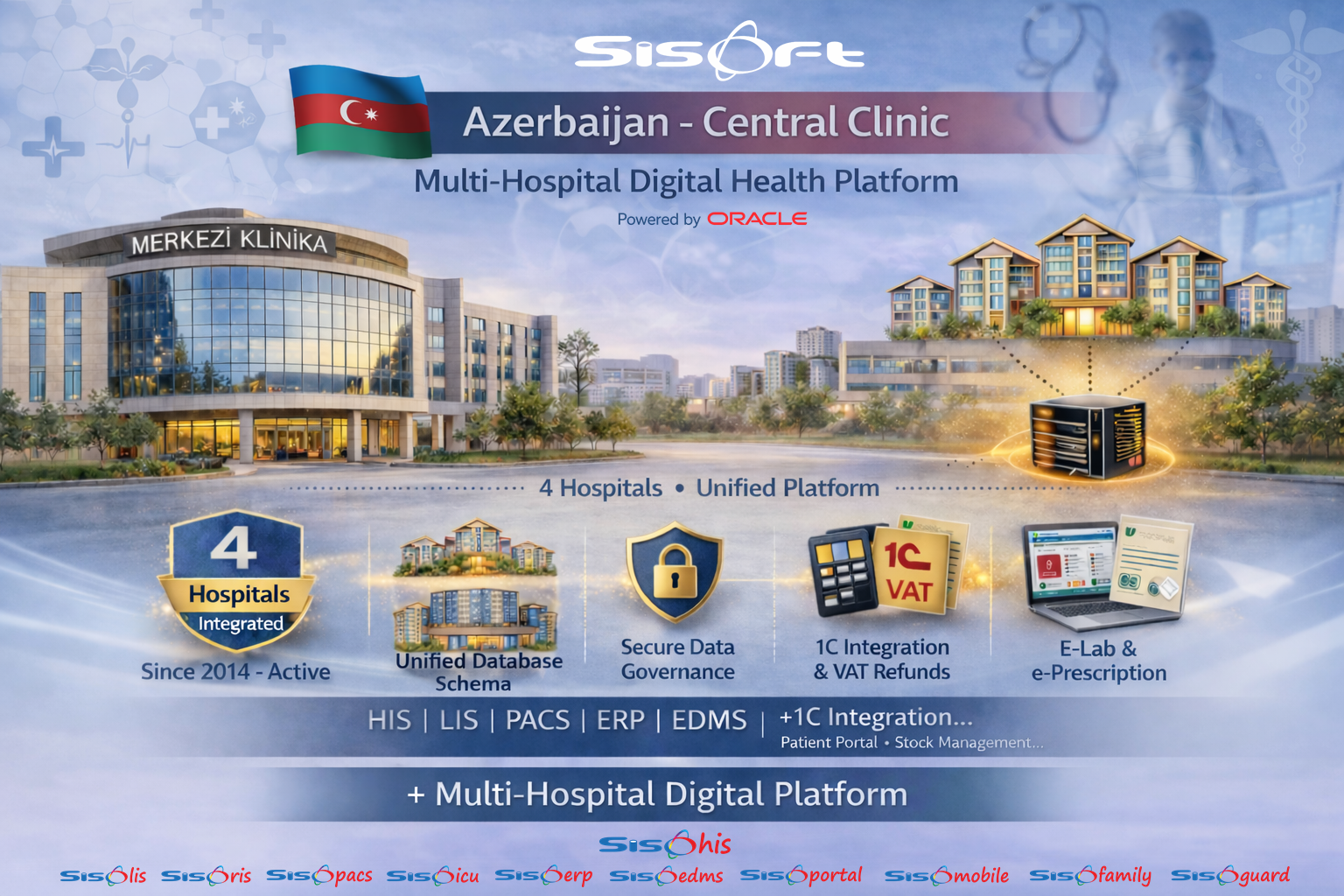
The project established a unified multi-hospital digital health platform across Central Clinic Azerbaijan, operating on a single database schema that enables real-time access to patient information across multiple healthcare facilities. The integrated platform combines clinical, administrative, laboratory, radiology, inventory, and financial workflows, improving care coordination and eliminating fragmented processes across hospitals.
The system enhanced patient safety, operational efficiency, and clinical decision-making by providing healthcare professionals with timely and accurate patient data. Local operational requirements were addressed through advanced inventory management, physician-based prescription workflows, and integration with national financial systems such as 1C for VAT refund processes.
The multilingual platform supports Azerbaijani, Turkish, Russian, and a 16+ language infrastructure, improving usability and adoption across diverse healthcare teams. Its scalable architecture enables expansion to additional hospitals and departments while maintaining unified data governance and role-based access control.
Operational since 2014, the system evolved into a customizable and resilient digital health infrastructure supporting four healthcare facilities under a single integrated platform. Key achievements include 100% electronic patient record management by 2017, a 60% reduction in manual administrative processes within two years, and full integration of multilingual, inventory, and financial workflows by 2018. The project demonstrates the impact of long-term digital transformation in building sustainable multi-hospital digital health ecosystems.
The implementation of a unified multi-hospital digital health platform across Central Clinic Azerbaijan presented both operational and technical challenges. One of the primary challenges was harmonizing clinical and administrative workflows across multiple facilities with different operational practices. Ensuring consistent data standards, user adoption, and workflow alignment required phased rollouts, intensive training, and continuous stakeholder engagement. Additionally, the system had to support users' language preferences, including Azerbaijani, Russian, and Turkish, requiring careful localization of clinical forms, workflows, and reporting structures while maintaining consistency across all facilities.
From a technical perspective, operating multiple hospitals under a single unified database schema required careful planning for data migration, system performance optimization, and high-availability architecture. Ensuring uninterrupted clinical operations during system transitions, implementing robust role-based access controls, and maintaining strong data governance across facilities were also critical challenges. Furthermore, adapting the platform to local operational and financial requirements—such as 1C integration for VAT refund processes and advanced inventory management—required additional customization and close coordination with local technical teams.
Successful implementation of the Central Clinic Azerbaijan multi-hospital digital health platform highlighted the importance of strong stakeholder engagement, phased deployment, and continuous user training. Early involvement of hospital leadership, clinical staff, and administrative teams enabled alignment of workflows and facilitated smoother adoption across multiple facilities. Establishing clear governance structures, defining standardized clinical and operational processes, and ensuring multilingual system availability significantly improved user acceptance and operational continuity.
Another key best practice was the implementation of a unified database schema across all hospitals, enabling real-time data access, improved coordination, and centralized reporting. This architecture supported scalability and allowed additional facilities and departments to be integrated without major system redesign. Strong role-based access control, centralized data governance, and modular system architecture further ensured sustainability, security, and long-term operational efficiency.
Additionally, the project demonstrated that a centralized yet flexible digital health infrastructure can serve as a foundation for future healthcare expansion. The platform’s scalable architecture enables integration with national health systems, additional hospitals, and new digital health services. This approach provides a sustainable model that can support the development of broader regional or national digital health ecosystems in the future.

