


RX Reader AI
Origin language: English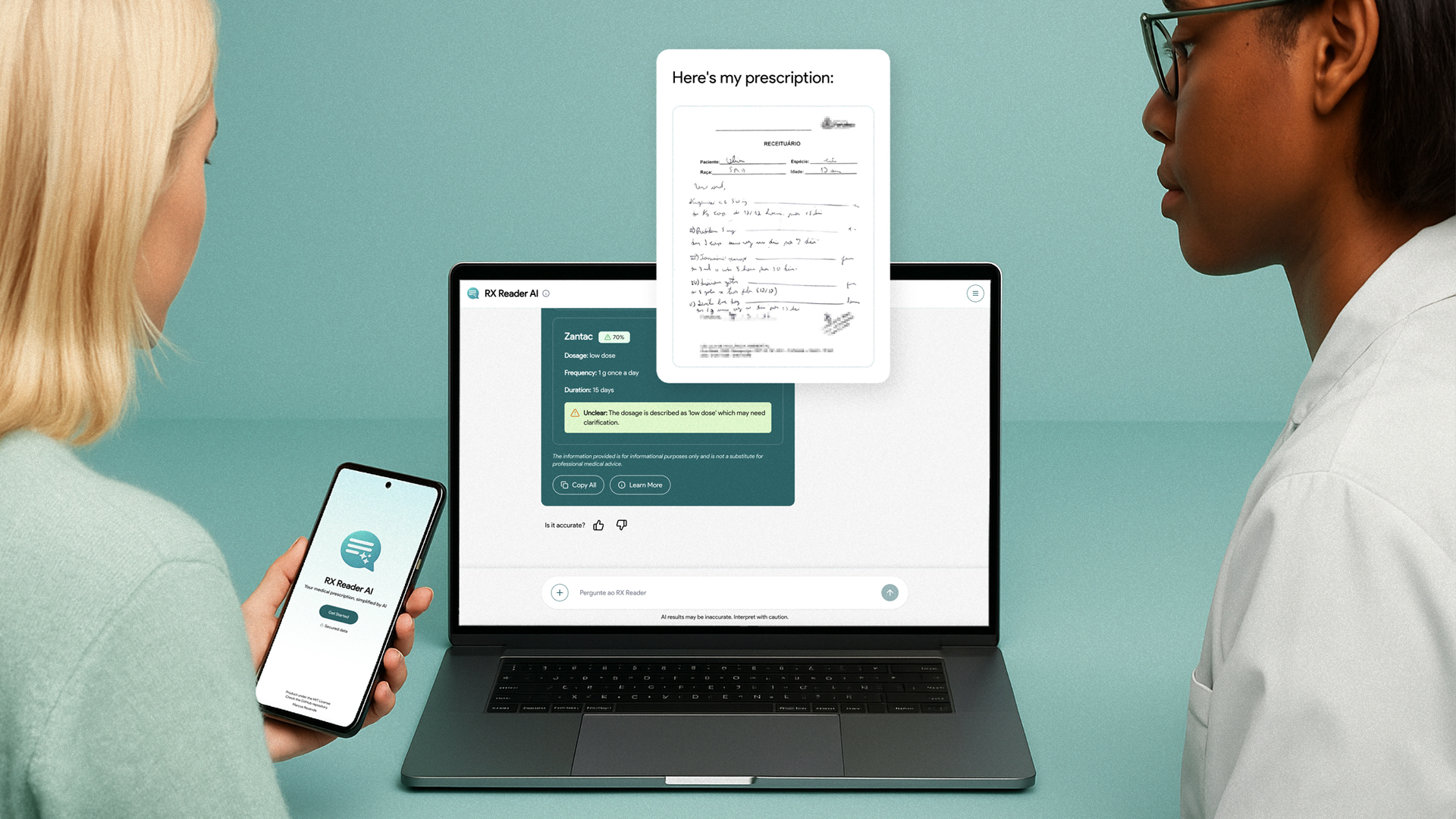
Country
Brazil
Coverage
International
Nb of implementation sites
N/A
Lead organization
Implementation partners
N/A
Health Focus Area
Medications/Pharmacy
Primary Health Care
Services
Decision Support
Pharmacy
Diagnostics
Enabling technologies
Computer Vision
Cloud Computing
Phone
Software
Artificial Intelligence
Standards
JSON
RxNORM
Tools
Funding sources
Others
Business model
Others
Funders
N/A
Summary
RX Reader AI addresses a significant challenge in healthcare by converting handwritten prescriptions into accurate and readable information using generative AI and computer vision. Primarily aimed at pharmacies and pharmacists in low-resource and high-volume settings, the tool tackles the issue of illegible prescriptions that contribute to medication errors, particularly in countries like Brazil, where many struggle to interpret handwritten notes.
The RX Reader platform processes prescriptions in real-time with just a photo, utilizing advanced image preprocessing, multilingual natural language processing (NLP) in English, Portuguese, and Spanish, and semantic drug matching. Pharmacists benefit from confidence scores, contextual alerts, and concise explanations, all provided through a privacy-first, mobile and web-friendly interface.
Initial usability tests among Brazilian pharmacists have shown positive feedback regarding the interface's clarity, confidence scoring, and its relevance to daily tasks. This empowers pharmacists to concentrate on safe dispensing and patient support instead of interpreting difficult handwriting.
More than just a technological solution, RX Reader embodies a responsible, human-centered approach to AI, advancing safety, accessibility, and equity in digital health. Plans to expand RX Reader's capabilities to multiple regions by 2027 aim to enhance global medication safety through inclusive design and localized prescription recognition, with a focus on elderly individuals, health professionals, rural communities, and adults.
Keywords
Digital health solutions
Decision support
Medication
Access to pharmacies and health care services
Artificial intelligence
Publications
Insights - Lessons learnt
Challenges
"- One of the main challenges faced during early testing was the variability in prescription image quality, due to poor lighting, smudged ink, or folded paper, especially in busy pharmacy settings; - Another challenge was balancing AI confidence transparency with usability. Pharmacists expressed concern about unclear results; - The lack of digital infrastructure in small or rural pharmacies highlighted the need for offline-capable, privacy-first design.; - . Legal clarity around AI in healthcare is still evolving and remains a barrier to rapid adoption."
Infrastructure availability
Results quality and reliability
Policy, regulatory and compliance barriers
Recommendations
To address this, we implemented robust image preprocessing (contrast, deskewing, binarization) and emphasized UX features like haptic alerts and feedback loops.; - creation of a “Confidence Mode” that flags uncertainty and suggests clear next steps. This feature improved trust and safety, and we recommend similar UX patterns in any AI-driven healthcare tool; - Adoption of a Progressive Web App model with no sign-in or data retention; Resistance to change was low thanks to early involvement of pharmacists in the design process, which we recommend as a best practice.
Scalability depends on localizing AI models for handwriting and language, and establishing academic or regulatory partnerships to validate performance in each country.
Recommendations
Projects using similar services
Projects focusing on similar topics
Projects with similar insights
iDHA (Project ID)
9qxit2
Project links
https://rxreader.aiOrigin of information
Project stakeholder
Data source link
N/AAdded to the platform on
2025-07-20
Project editors
Last update by
Alexis Baudin on 2025-07-27
Number of views
393
WHO classifications

