


NESTOR — Neurosyphilis: Extraction via Scanned Texts and OCR for medical Research
Origin language: English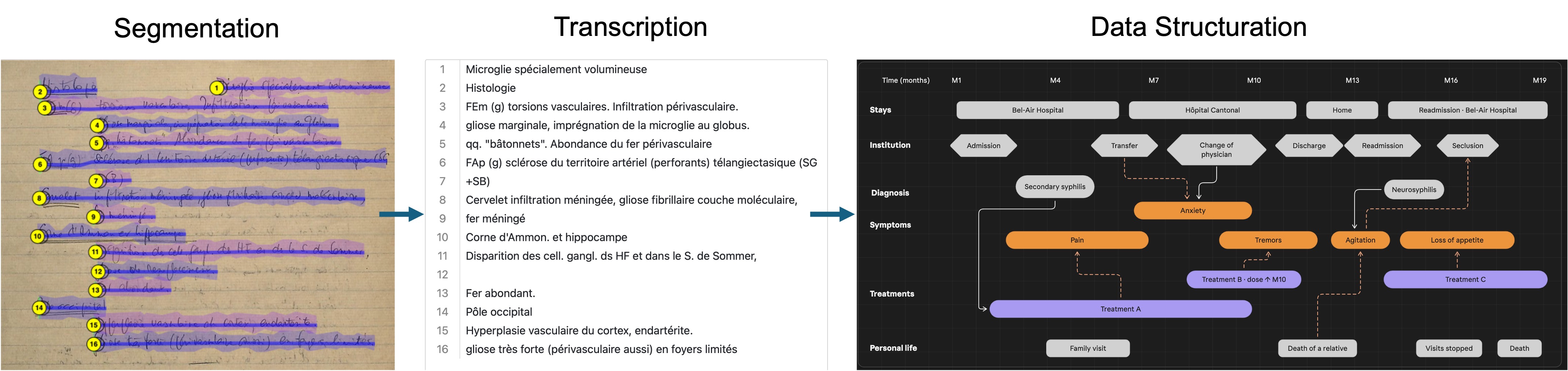
NESTOR (Neurosyphilis: Extraction via Scanned Texts and OCR for medical Research) is an interdisciplinary project from the University of Geneva and Geneva University Hospitals that unlocks handwritten medical archives for research.
The problem: hospitals, archives and biobanks preserve vast collections of handwritten patient files, registries and inventories documenting decades of clinical practice. These records are a unique source on historical clinical practice, but they remain largely inaccessible: manual transcription is slow and costly, conventional Optical Character Recognition (OCR) performs poorly on handwriting, and patient confidentiality rules out most commercial cloud tools.
The approach: NESTOR adapts handwritten text recognition methods from the digital humanities, a field experienced in transcribing historical manuscripts. A foundation model trained on over 20 000 pages spanning five centuries and five languages was fine-tuned on records from the Geneva Brain Bank, a collection founded in 1901 that holds clinical data on more than 11 000 patients. Using around 500 manually-transcribed pages written in French between 1883 and 1980, the fine-tuned model adapted for such archives reaches 87% of accuracy. The pipeline is fully open-source, free, and runs offline on a standard laptop, so adapted to sensitive data. It requires minimal domain-specific annotation and relies on non-medical training data, avoiding the ethical barriers of sharing medical manuscripts. It can therefore be replicated across hospitals and archives, and in resource-limited settings where handwritten medical records are still produced today.

