


JudeBiome
Origin language: English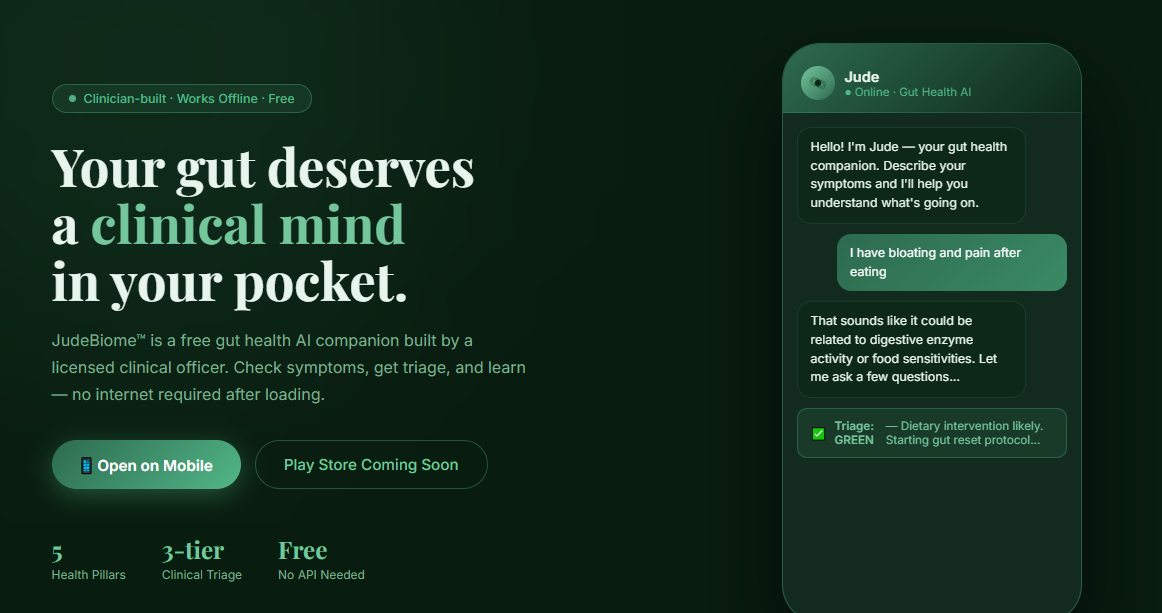
JudeBiome is a free, mobile-first AI gut health companion built and medically directed by Ronald Aduda, a Licensed Clinical Officer at Molegru'm GHL in Kenya. It provides clinically grounded guidance for digestive symptoms through three core features: a conversational AI chat with Jude, a structured 5-step Gut Health Checker covering symptoms, stool patterns, diet, lifestyle, and red-flag screening, and a 5-pillar clinical education system. A built-in 3-tier triage system (Green/Amber/Red) automatically identifies when users require urgent medical attention, reducing dangerous self-neglect. The platform operates offline, making it accessible in low-connectivity environments across East Africa. JudeBiome is free to end users and is linked to The Molegru'm Gut Reset Protocol for users requiring deeper structured intervention. It represents a clinician-led approach to democratizing gut health knowledge in underserved populations globally.
Building clinical credibility in a digital health space dominated by generic wellness content required positioning JudeBiome as a clinician-led tool from the outset, not an afterthought. Ensuring the AI triage system defaulted conservatively — routing ambiguous symptoms toward professional care rather than self-management — required deliberate guardrail design to prevent false reassurance, particularly for symptom combinations with serious differential diagnoses. Reaching users in low-connectivity environments in East Africa required offline-capable architecture. Awareness and distribution remain the primary growth challenge at this stage, as user trust in AI health tools is still developing in the Kenyan market. Self-funding has limited infrastructure investment and delayed the native mobile app launch
Establishing clinical authorship and oversight as a foundational design principle — not a compliance afterthought — significantly improved the credibility and safety of the tool. Building the triage system on a structured 5-step checker rather than free-form AI responses reduced the risk of premature or inaccurate verdicts. Making the platform free to end users while linking to a paid protocol product created a sustainable freemium model without compromising access. Using existing clinical knowledge frameworks (the 5 Molegru'm pillars) as the education architecture ensured content consistency across all sections of the app. Deploying on Vercel with offline fallback capability addressed connectivity barriers common in East African markets without requiring additional infrastructure investment

