


Global Healthsites Mapping Project
Origin language: English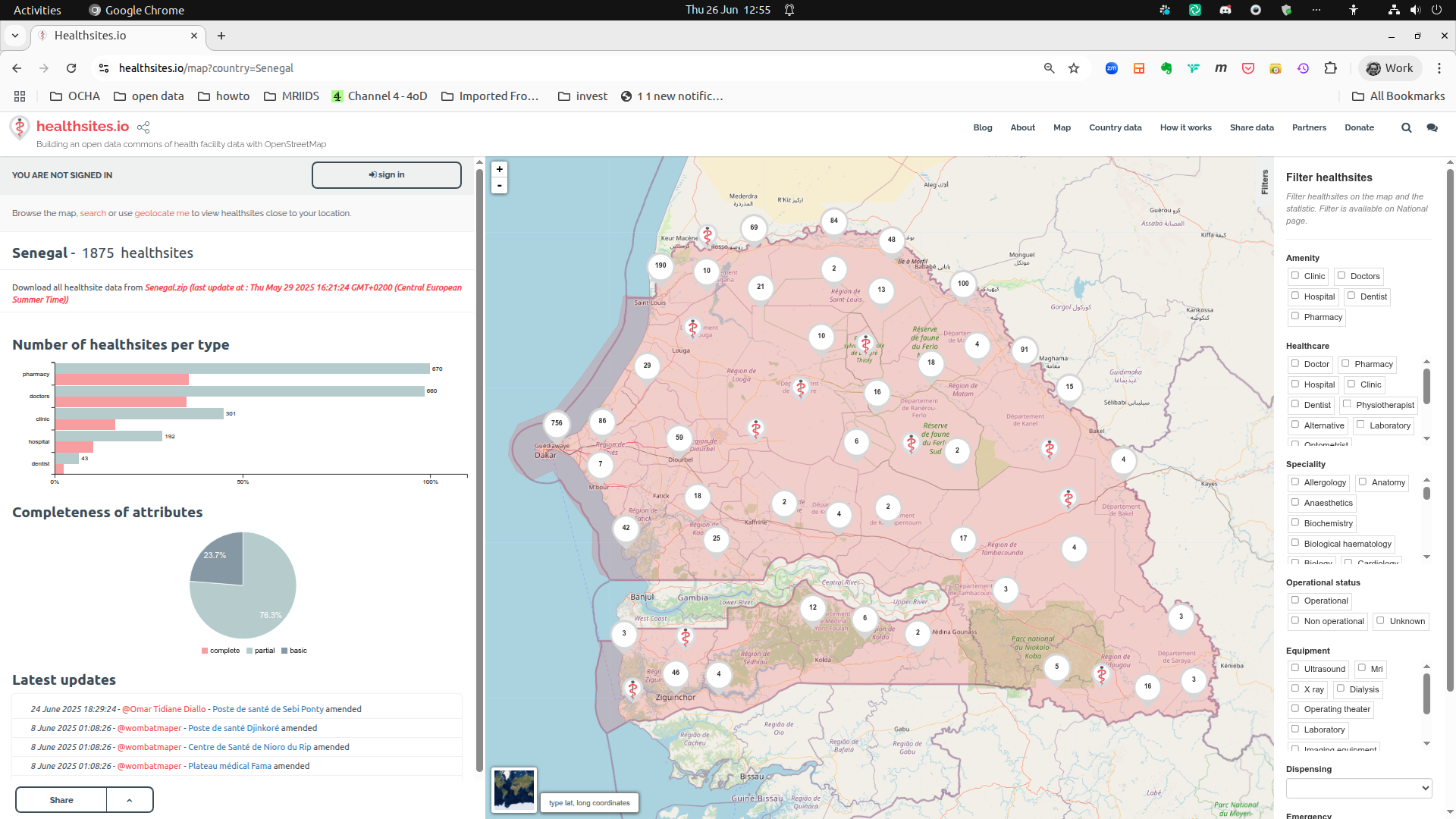
Country
Senegal
Coverage
International
Nb of implementation sites
2
Lead organization
N/A
Implementation partners
N/A
Health Focus Area
Skin diseases
Primary Health Care
All
Sexual and Reproductive Health
Vaccination / Immunization
Maternal and child health
Communicable diseases
Emergencies
Medications/Pharmacy
Services
Telehealth
Emergency preparedness and response
Decision Support
Geographic Information Systems (GIS)
Health Management Information Systems (HMIS)
Enabling technologies
Other
Standards
JSON
Xforms
Tools
N/A
Funding sources
Donors
Business model
Others
Funders
Summary
Goal - Accurate and open baseline health facility data that lives in OpenStreetMap
Key activities:
Support Human Centered Design to drive the development of the data
Enable stakeholders in the health cluster to share health facility data to OpenStreetMap
Support collaboration between national health agencies and field validation teams
Connect multiple data streams to build higher quality data
When a natural disaster or disease outbreak occurs there is a rush to establish accurate health care
location data that can be used to support people on the ground. This has been demonstrated by events
such as the Haiti earthquake and the Ebola epidemic in West Africa. As a result valuable time is wasted
establishing accurate and accessible baseline data. healthsites.io establishes this data and the tools
necessary to upload, manage and make the data easily accessible.
Healthsites.io, uses OpenStreetMap (OSM) as its data store, and provides a collaborative platform to
enhance health facility data quality through an open science approach. By enabling community
contributions and validation OSM allows stakeholders to update and verify geospatial data, ensuring it is
accurate, up-to-date, and reflective of real-world conditions. This open model fosters a global network for
continuous data improvement, supporting better health system planning, emergency response, and
public health decision-making.
A data collaborative
The collaborative is a semi-formal network that identifies and shares baseline health facility data. It works
to identify data gaps and supports stakeholders with sharing and the use of data especially for
decision-making. Crucially, validated data is saved to OpenStreetMap which means that successive
projects are able to benefit from the work even when programs end.
Use cases
Epidemic Preparedness - Accurate health facility data is a vital asset when responding to outbreak
events.
Support for disaster response - A baseline of health facility data is a vital asset of first responders.
Support for immunization programs - Accurate health capacity data supports immunization
planning on the national scale.
Maternity health - Updated maternal health services support midwives and pregnant women
Health capacity planning - Understanding the current capacity and identifying any gaps or
deficiencies.
Support for Social entrepreneurs - Developing an enabling environment for entrepreneurs
focused on improving health outcomes
Alignment with the Global Funds COVID-19 Response Mechanism (C19RM)
Intervention & Key activities:
Develop or update georeferenced master lists of health facilities (public and private)
Optimize outreach activities to ensure all communities are reached
Establish geospatial governance
Establish GIS technical capacity with OpenStreetMap focused training programs
Keywords
Access to pharmacies and health care services
Pregnant mothers
Health facilities
Maternal care
Capacity building
Publications
Insights - Lessons learnt
Challenges
Data Sharing Assumption: Stakeholders will actively share baseline health facility data and support the business case for an accurate baseline of health facility data. Reality: Ministries of Health, NGOs, and Intergovernmental Organizations often refrain from open data sharing. Open data requirements, like OpenStreetMap’s attribution and change tracking, deter sharing due to privacy and security concerns, especially in sensitive regions. The lack of data governance policies and the costs associated with sharing further hinder contributions from organisations such as Ministries of Health and Red Cross Federations. Sustainable Project Investment Assumption: Public-private partnerships will drive impact investment, ensuring the project's sustainability by achieving SDG 3.8.1 (coverage of essential health services). Blended finance from institutions like the World Bank can create compelling opportunities for investors, delivering long-term financial and social returns. Reality: While healthsites.io data is well-received and in demand via platforms like the Humanitarian Data Exchange (HDX), a sustainable business model recognizing the value of accurate, accessible health facility data supporting the Coverage of essential health services (SDG 3.8.1) and health systems strengthening has yet to materialize. The success of healthsites.io's work in Senegal has not yet been fully integrated into Intergovernmental Organizations (IGOs) through a viable business model. Engagement & Operational Challenges Assumption: Ministries of Health and IGOs will actively connect healthsites.io with relevant programs (e.g., HIV, TB, Malaria). Reality: While the Senegalese Ministry of Health (MoH) utilizes shared health facility data, there is no formal integration of healthsites.io or OpenStreetMap Senegal's capacity into ongoing operations or programs that rely on this data. Limited collaboration with the National Statistics Office (NSO) and Ministry of Finance weakens support for the MoH’s strategic objectives. Furthermore, efforts to present to Senegal’s Country Coordinating Mechanism (CCM) have faced challenges, despite the Centre des Opérations d'Urgence Sanitaire and Saint-Louis Regional Ministry of Health responding positively to the shared data.
Recommendations
N/A
Recommendations
Projects using similar services
Projects focusing on similar topics
Projects with similar insights
iDHA (Project ID)
ioxjsi
Project links
https://healthsites.io/Origin of information
Project stakeholder
Data source link
N/AAdded to the platform on
2025-06-26
Project editors
Last update by
Aziza Merzouki on 2025-07-02
Number of views
133
WHO classifications

