


Algerian Military Mother and Child Hospital — Secure Integrated Digital Health Platform
Origin language: English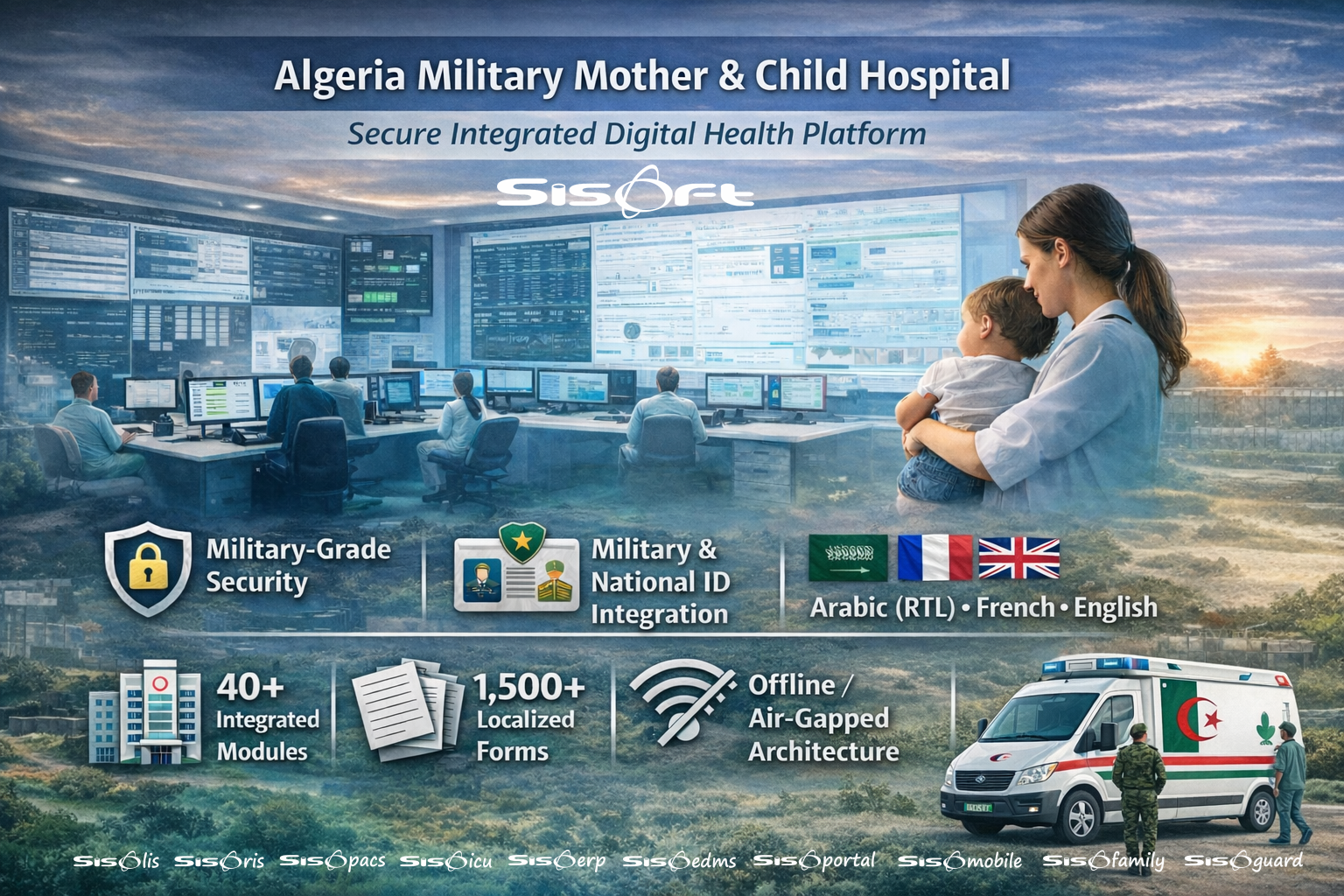
This project involves the implementation of a fully integrated, high-security digital health platform at a Military Mother and Child Hospital in Algeria. The system was designed for a military healthcare environment where confidentiality, operational continuity, and data security are critical requirements.
The solution integrates clinical, administrative, and operational workflows into a unified Hospital Information System, enabling real-time access to patient data, improved care coordination, and data-driven decision-making.
More than 40 modules and 1,500 localized French and Arabic forms were implemented. The platform supports multilingual operation (Arabic RTL, French, English), national and military identity integration, and secure air-gapped architecture with role-based access and comprehensive audit logging.
Implementing a fully integrated digital health platform in a military hospital environment introduced significant operational and technical challenges. The system was required to operate in a fully offline, air-gapped environment with no internet connectivity, limiting remote access, updates, and integration approaches. Strict military security policies required multi-layered security controls, including role-based access, cross-authorization checks, and additional validation mechanisms at both user and application server levels. Even internal network access was subject to enhanced security restrictions, requiring careful architecture design and phased deployment to ensure uninterrupted clinical operations.
Additionally, the migration of legacy data had to be performed entirely on-site without transferring sensitive information outside the secure environment. Existing clinical and administrative records were securely transferred and validated within the hospital infrastructure. Extensive localization was also required to support Arabic (RTL), French, and English workflows, while continuous customization, user training, and operational optimization were carried out to adapt the system to evolving military healthcare requirements.
Strong stakeholder engagement and continuous collaboration with hospital leadership, clinical teams, and IT personnel were critical to the successful implementation. A phased deployment approach allowed gradual adaptation to digital workflows while minimizing operational risks. On-site implementation, training, and support ensured that security requirements and operational continuity were maintained in the high-security military environment. Localization of workflows, forms, and user interfaces in Arabic (RTL), French, and English significantly improved user adoption and operational efficiency.
Another key best practice was designing the system with a centralized yet secure architecture capable of operating in offline and air-gapped environments. This ensured sustainability and operational resilience while maintaining strict data sovereignty. The extensive customization and modular architecture developed during the project also created a scalable digital health framework that can support future high-security healthcare environments, military hospitals, and potential national-level deployments.
Furthermore, the implemented architecture provides a strong foundation for the future development of a centralized military e-health ecosystem operating over closed and secure networks. This approach can serve as a reference model for digital transformation across military healthcare systems, enabling secure data sharing, standardized workflows, and coordinated healthcare delivery across multiple military health facilities.

