


SALGINTR
Origin language: English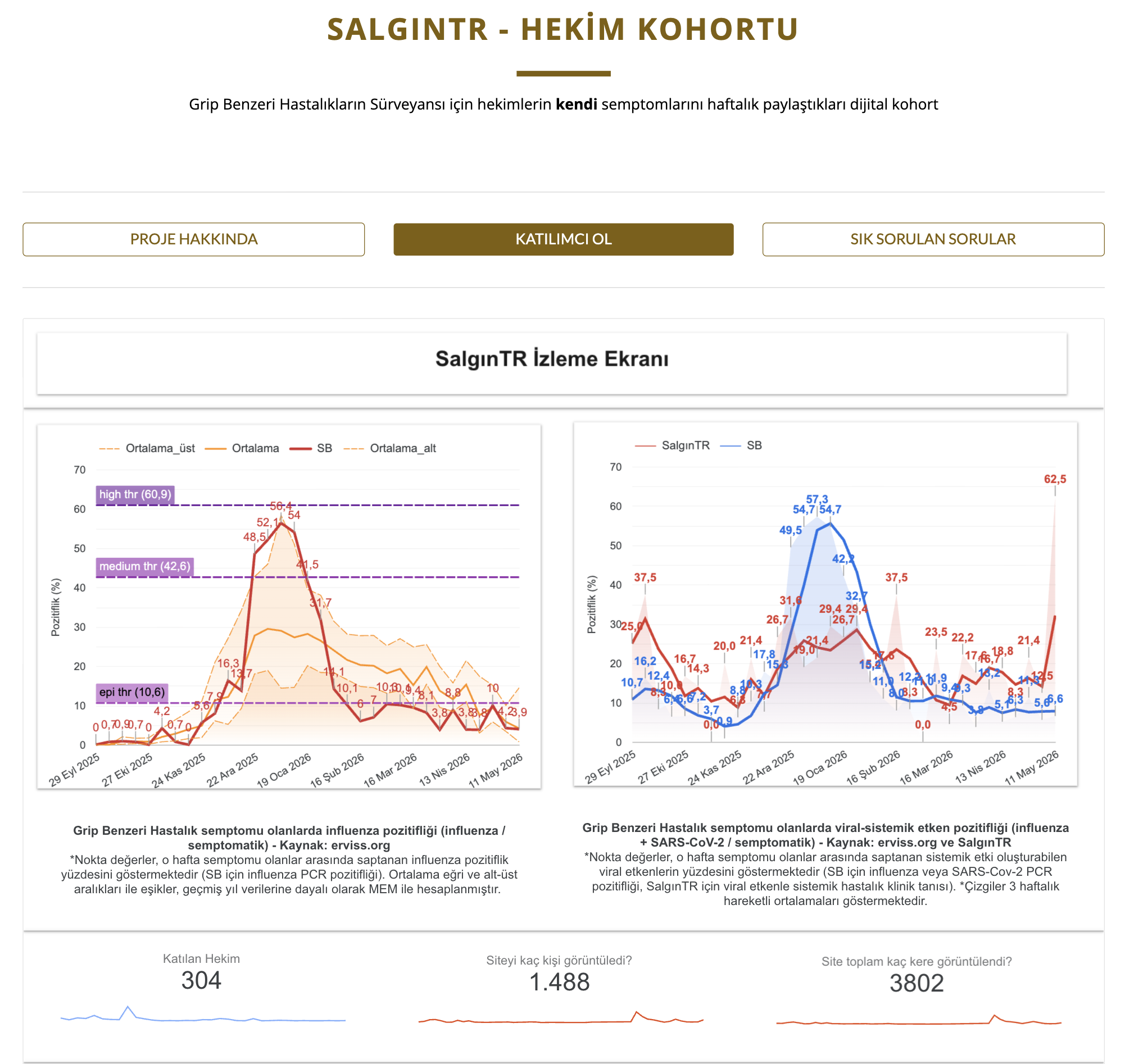
Country
Turkey
Coverage
National
Nb of implementation sites
81
Lead organization
Ankara University, Faculty of Medicine
Middle East Technical University, Graduate School of Informatics
Implementation partners
N/A
Health Focus Area
Communicable diseases
Vaccination / Immunization
Primary Health Care
Services
Community-based information systems
Immunization
Public health and disease surveillance
Enabling technologies
Artificial Intelligence
Cloud Computing
Big Data Analytics
Low Code - No Code
Standards
ICD-11
ICD-10
Tools
Funding sources
Others
Business model
No business model
Funders
N/A
Summary
SALGINTR is a digital participatory surveillance system aimed at the early detection and monitoring of influenza-like illness (ILI) trends in Türkiye. It utilizes self-reported health data from a voluntary group of physicians to provide near real-time insights into respiratory illness activities, often ahead of traditional surveillance methods.
The system addresses common challenges in conventional surveillance, such as delays and under-detection, by employing a cost-effective, scalable digital data collection method combined with automated analytics and early warning algorithms. This allows for timely alerts, epidemic thresholds, and trend forecasts that are crucial for public health decision-making.
Focusing on simplicity, data integrity, and sustainability, SALGINTR showcases the effectiveness of digital health strategies in enhancing national surveillance capabilities and improving health system resilience, particularly in middle-income countries. The goal is to establish a physician-based ILI surveillance system capable of detecting seasonal outbreaks sooner than routine methods and producing weekly situational reports by 2025-2026, as demonstrated in its pilot phase. The project's health focus areas include communicable diseases, vaccination/immunization, and primary health care, targeting health professionals and adults aged 18 and above.
Keywords
Epidemiology
Surveillance
Academic and research
Outbreak services
Pandemic preparedness
Publications
SALGINTR: development and early evaluation of a low-cost cloud-based digital participatory surveillance system for influenza-like Illness among physicians in Türkiye — a proof of conceptInsights - Lessons learnt
Challenges
The implementation of SALGINTR highlighted several process-related, technical, and contextual challenges that are common to digital public health surveillance initiatives. A key challenge was sustaining long-term engagement among voluntary physician participants in the absence of financial incentives. This was addressed through simplified reporting workflows, regular feedback via dashboards, and emphasizing the public health value of participation. From a technical perspective, ensuring data completeness and temporal consistency in self-reported syndromic data required iterative refinement of data validation rules and analytic pipelines. Contextually, the absence of routine data interoperability with national health information systems limited real-time linkage with laboratory and healthcare utilization data.
Recommendations
Variability in clinical interpretation of influenza-like illness symptoms was mitigated by adopting standardized case definitions aligned with ICD frameworks and providing clear guidance to participants. Operating independently from formal reporting structures allowed rapid piloting, methodological flexibility, and ethical governance within an academic framework. Key enabling factors included strong academic leadership, early involvement of clinicians as co-producers of data, and the use of low-cost, widely available digital tools. Best practices identified include prioritizing simplicity over technological complexity, transparency in analytics, and incremental scaling. For sustainability and scale-up, future integration with national surveillance systems, alignment with International Health Regulations (IHR) core capacities, and formal data-sharing agreements are recommended. SALGINTR demonstrates that participatory digital surveillance can complement routine systems and strengthen epidemic preparedness in middle-income settings.
Recommendations
Projects using similar services
Projects focusing on similar topics
Projects with similar insights
iDHA (Project ID)
rby3e7
Project links
https://www.salgin.com.trOrigin of information
Project stakeholder
Data source link
N/AAdded to the platform on
2026-01-25
Project editors
Last update by
Eray Öntaş on 2026-08-04
Number of views
223
WHO classifications

