


Integrated Healthcare ERP & Hospital Resource Management Platform (SisoERP)
Origin language: English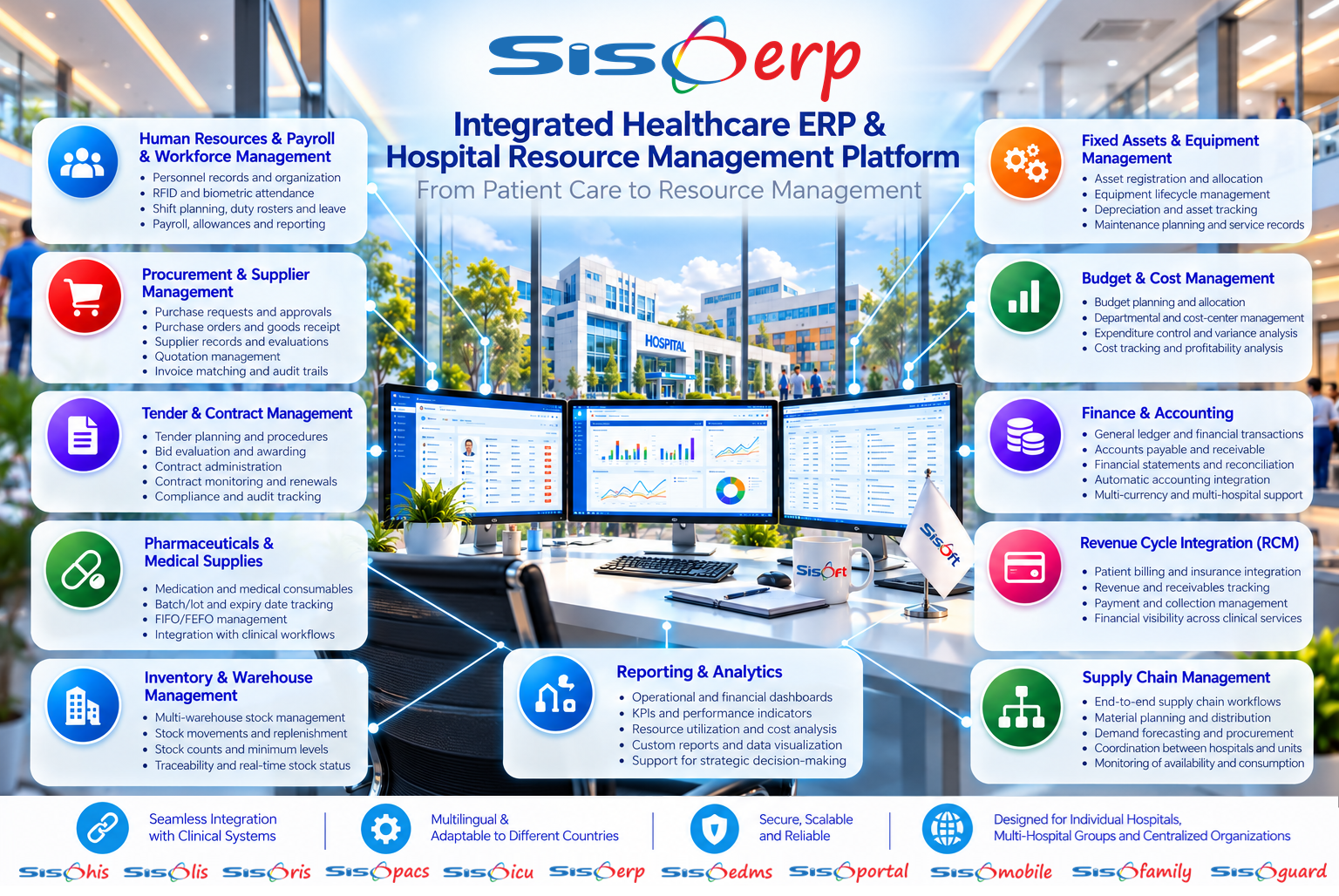
SisoERP is an Integrated Healthcare ERP & Hospital Resource Management Platform developed by Sisoft, a healthcare technology company established in 1987. It unifies clinical, administrative, financial, and operational processes within the Sisoft Integrated Digital Health Platform.
Unlike conventional ERP solutions, SisoERP connects hospital resource management directly with patient care, enabling healthcare organizations to manage personnel, finances, procurement, inventory, assets, and supply chains in one integrated environment.
Core capabilities include:
• Human Resources & Payroll: Personnel administration, organizational structures, RFID-based attendance tracking, shifts, duty rosters, leave, overtime, salaries, and benefits.
• Procurement & Tender Management: Purchase requests, approvals, supplier management, quotations, tenders, contracts, and purchasing workflows.
• Inventory & Warehouse Management: Multi-warehouse operations, stock transfers, replenishment, consumption monitoring, and traceability.
• Pharmaceuticals & Medical Supplies: Medication and consumable management, batch/lot tracking, expiry monitoring, FIFO/FEFO, and departmental stock consumption.
• Fixed Assets & Equipment: Asset registration, allocation, transfers, lifecycle management, and depreciation.
• Finance, Accounting & Budgeting: General ledger, payables, receivables, financial reporting, budget planning, cost centers, and expenditure control.
• Supply Chain Management: Procurement, storage, distribution, and material availability across hospital departments.
• Revenue Cycle Integration (RCM): Patient billing, insurance authorization, receivables, payments, and revenue monitoring.
• Reporting & Analytics: Real-time dashboards, operational and financial KPIs, cost analysis, resource utilization, and management reporting.
Through native integration with SisoHIS, clinical activities are linked to resource consumption, inventory movements, operational costs, and financial transactions, improving efficiency, transparency, and accountability.
SisoERP supports multilingual environments, individual hospitals, hospital chains, and centralized healthcare networks, adapting to country-specific requirements.
By 2027, the project aims to strengthen hospital resource management, financial sustainability, and real-time, data-driven decision-making.
Implementing an integrated Healthcare ERP across diverse hospital environments presents technical, organizational, and regulatory challenges.
- Legacy Systems & Integration: Connecting existing clinical, financial, HR, inventory, and procurement systems requires complex data migration, interoperability, and synchronization while maintaining operational continuity.
- Resistance to Change: Transitioning from paper-based or fragmented workflows to integrated digital processes requires staff training, stakeholder engagement, and organizational adaptation.
- Country-Specific Requirements: Differences in taxation, payroll, accounting, procurement regulations, labor laws, and healthcare financing models require extensive localization and configurable workflows.
- Data Quality & Security: Maintaining accurate financial, personnel, pharmaceutical, and inventory records demands strong access controls, audit trails, data validation, and privacy safeguards.
- Operational Complexity: Managing multiple hospitals, warehouses, cost centers, suppliers, and approval hierarchies requires scalable architecture and standardized processes.
- Infrastructure & Sustainability: Limited connectivity, legacy infrastructure, budget constraints, and evolving regulations can affect implementation timelines and long-term maintenance.
Sisoft addresses these challenges through modular deployment, integration with SisoHIS, configurable workflows, multilingual support, training, and continuous system improvement.
Successful Healthcare ERP implementation requires more than software deployment. Sisoft's international experience since 1987 highlights the importance of integrating clinical, administrative, financial, and operational processes while adapting to local healthcare requirements.
- Stakeholder Engagement: Involve hospital executives, clinicians, finance, HR, procurement, pharmacy, and IT teams throughout implementation. Strong leadership and user participation improve adoption.
- Integrated Architecture: Connect ERP functions with HIS workflows through a unified data environment. Linking clinical activities to inventory, resource consumption, costs, and financial operations reduces duplication and improves transparency.
- Phased Implementation: Deploy modules progressively, prioritizing essential operations. Conduct data validation, workflow testing, user training, and controlled transitions to minimize disruption.
- Localization & Compliance: Adapt payroll, taxation, accounting, procurement, approval hierarchies, and reporting to national regulations. Multilingual interfaces and configurable workflows support scalability.
- Inventory & Financial Control: Apply barcode identification, batch/lot traceability, FIFO/FEFO, cost-center monitoring, and automated approvals to strengthen accountability.
- Security & Governance: Implement role-based access, audit trails, data protection, backup procedures, and business continuity measures.
- Sustainability & Scalability: Build local capacity through training, knowledge transfer, technical support, and modular expansion. Support centralized and multi-hospital deployments.
- Continuous Improvement: Use dashboards, KPIs, operational feedback, and performance monitoring to guide improvements and evidence-based management.
These practices support efficient resource utilization, financial sustainability, organizational resilience, and adaptable digital healthcare transformation.

